
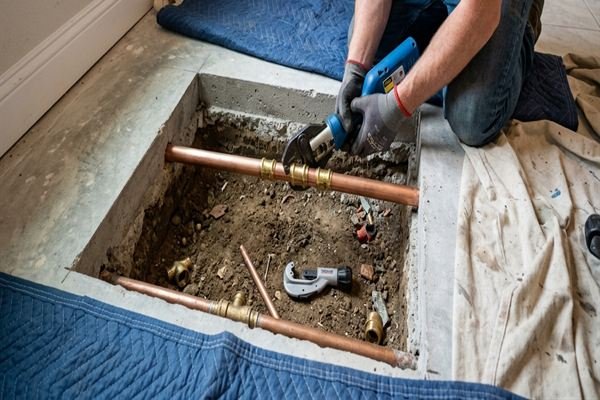
Comprehensive Slab Leak Repair in Washington State
A slab leak is one of the most critical structural plumbing emergencies a homeowner can experience. In concrete slab-on-grade construction—common throughout Western Washington subdivisions, Puget Sound mid-century developments, and Spokane properties—pressurized copper water supply lines and drain pipes are encased directly beneath structural concrete footings.
When one of these subterranean pipes fractures, corrodes, or separates, gallons of pressurized water escape continuously into the gravel bedding and soil substrate beneath your foundation. Left unaddressed, this hydrostatic pressure can undermine sub-slab soil, cause foundation cracking, lift hardwood flooring, saturate wall framing, and trigger hazardous black mold proliferation.
Why Washington Homes Are Particularly Vulnerable
Washington State's unique climatic and geological factors make homes across King, Snohomish, Pierce, Spokane, and Clark Counties especially susceptible to slab leaks:
- Glacial Till & Soil Expansion: The Pacific Northwest features dense glacial till and expansive clay soils that swell during wet winter months and contract during dry summer seasons, placing intense mechanical shear stress on buried copper pipes.
- Acidic & Soft Municipal Water: In many Washington water districts, water with low mineral hardness and mild acidity reacts chemically with copper pipe walls, leading to interior scouring and pinhole perforation over 15 to 25 years.
- Direct Aggregate Contact: In homes built between the 1960s and early 2000s, plumbers frequently placed unprotected type M or L copper lines directly against crushed basalt rock before pouring concrete. Decades of micro-vibrations from water flow cause the rocks to wear through the pipe wall.
Our 3 Engineering Approaches to Slab Leak Repair
At Ever Leak Plumbing Washington, we reject the old-fashioned "jackhammer first" approach. After non-destructively locating your leak to the exact square inch, we present you with the most viable, long-lasting repair methodologies:
1. Overhead PEX Bypass Rerouting (Recommended Permanent Fix)
Rather than tearing up your finished tile, hardwood, or carpet to access an old pipe, our technicians cap and abandon the compromised subterranean copper line completely. We run flexible, freeze-resistant Uponor PEX-a water lines through attic spaces, interior wall cavities, or crawl space chases.
Advantages: 100% preserves your finished flooring, eliminates any future risk of under-slab leaks on that line, includes a 25-year manufacturer warranty, and can often be completed in a single day.
2. Non-Invasive Trenchless Epoxy Pipe Relining (CIPP)
For sewer and drainage lines located beneath concrete slabs, we utilize pneumatic cured-in-place pipe (CIPP) relining. We clean the line via hydro-jetting, insert an epoxy-saturated sleeve, and cure it into a continuous, seamless, root-proof pipe inside the existing conduit without breaking concrete.
3. Surgical Direct Slab Spot Repair
If your plumbing system is relatively new and suffered an isolated mechanical failure (such as a nail strike or localized fitting defect), we execute surgical concrete penetration. We open a neat 2'x2' access hole, excise the damaged copper segment, silver-braze a heavy-duty Type K copper replacement, install protective polyethylene sleeving, and repour structural concrete with an intact vapor barrier.
Step-by-Step Diagnostic & Repair Workflow
- Digital Manometer Pressure Test: We confirm whether the pressurized leak is on the cold water line, hot water line, or drainage system.
- FLIR Thermal Infrared Scan: High-resolution thermal cameras capture heat halos radiating through the slab from hot-water line ruptures.
- Acoustic Listening Disc & Sonar: We listen to the subterranean hiss of escaping pressurized water using amplified digital transducers.
- Transparent Upfront Proposal: You receive a clear, fixed-price quote detailing rerouting vs. spot repair options.
- Execution & Verification: The repair is executed by licensed WA master plumbers and pressure-tested for 100% seal integrity.
- Insurance Claim Dossier: We deliver a photographic report and itemized billing statement for your insurance adjuster.
Washington Homeowners Insurance Coverage Assistance
Most major Washington homeowners insurance providers (including State Farm, Allstate, Travelers, Liberty Mutual, and Farmers) cover:
- The cost of tear-out and access to reach the failed pipe underneath the slab.
- Restoration of damaged subflooring, hardwood, tile, carpet, and drywall.
- Professional structural drying and dehumidification.
Ever Leak Plumbing works directly with your adjuster to ensure smooth claims processing with full photographic documentation.
Emergency Dispatch Tip
If you suspect an active under-slab leak, locate your main water shutoff valve (usually situated near your water heater or front curb) and turn it off clockwise. Then call our 24/7 hotline at (833) 632-3270 for immediate dispatch.
Our 10 Specialized Plumbing Services Available in Washington State
Every foundation leak requires precision engineering. Explore our complete suite of non-invasive diagnostics and permanent repair solutions with 24/7 Washington emergency dispatch:
Featured Washington Service Areas
We dispatch master plumbing technicians across all 195+ Washington communities. Read our dedicated local slab leak repair and detection guides for your area:
Slab Leak Repair FAQs
If your home is over 15–20 years old and has original copper pipes under the slab, a spot repair is often a temporary fix because the rest of the pipe is the same age and condition. An overhead PEX reroute is usually the superior investment because it permanently removes water lines from underneath your concrete foundation, ensuring you never have another slab leak on that line.
Yes. Continuous pressurized water washes away supporting gravel and sandy loam from underneath the concrete. As voids form, the unsupported slab will settle unevenly under the weight of the house, resulting in cracked foundation slabs, jammed doors and windows, and tilted floors.
Non-invasive electronic leak detection usually takes 1 to 2 hours. A direct spot repair takes approximately 4 to 8 hours. An overhead PEX reroute for an entire line or multi-bathroom residence typically takes 1 to 2 days, during which our team ensures your water service is restored by the end of each working day.